
$201.80
Add to Cart
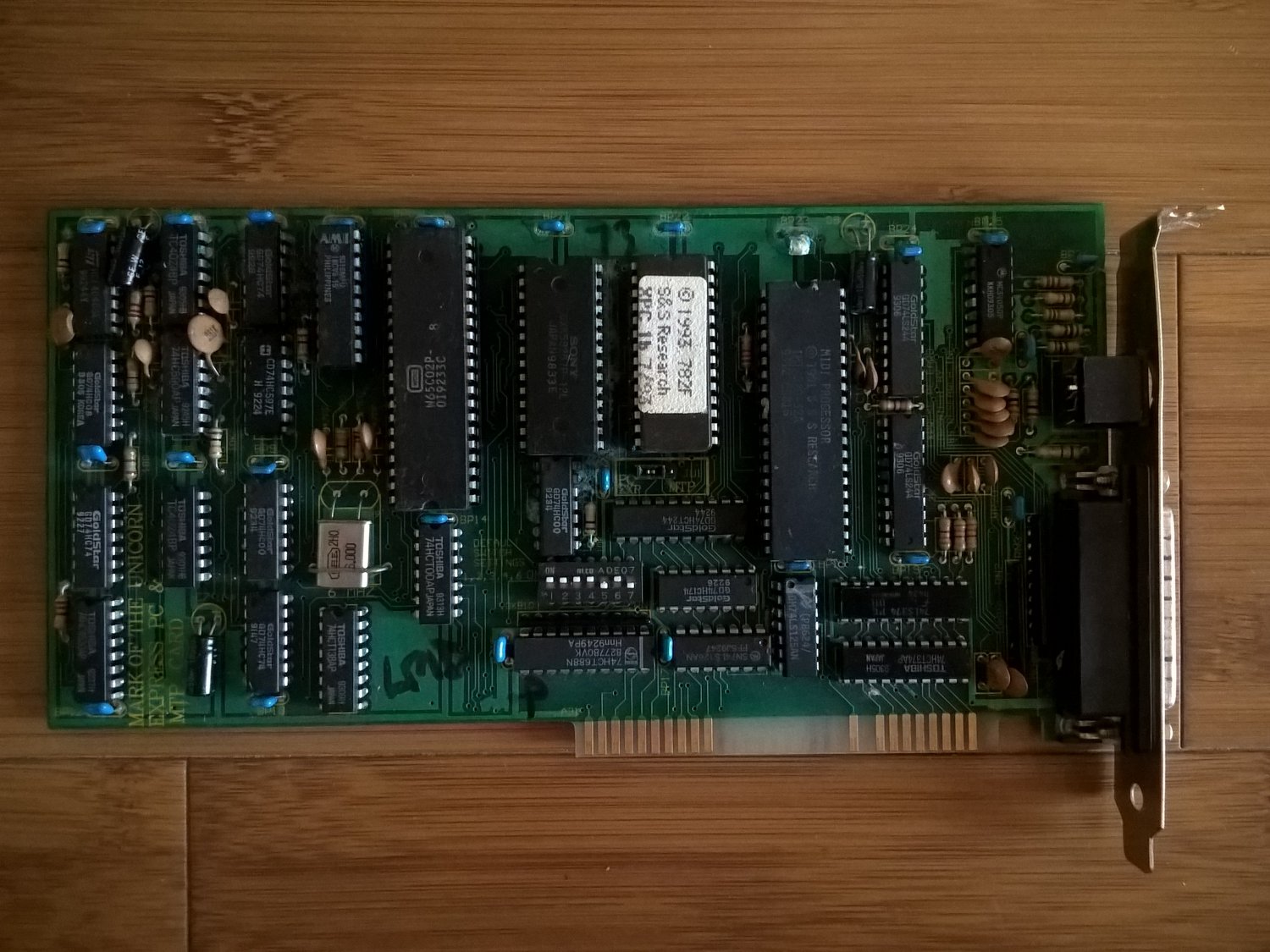
Mark Of The Unicorn Express PC MTP Card, 8-Bit ISA, MOTU MIDI S&S Research


Mark Of The Unicorn Express PC MTP Card, 8-Bit ISA, MOTU MIDI S&S Research
Appearance: Used
Functionality: Working
Description:
============
As pictured, a Mark Of The Unicorn Express PC MTP Card. Includes just the bare card – no other accessories are available. Drivers and specs are available at http://www.oldschooldaw.com/forums/index.php?topic=566.0.
Warranty and Returns:
=====================
We understand that there may be compatibility issues, space constraints, or it just doesn’t look perfect. This item can be returned within 14-days for ANY reason. However, shipping to and from is not refundable.
Shipping:
=========
- Other shipping methods are available – contact us for details.
- Combined shipping is available for most items – contact us for details.
- Local pickup is also available at no cost.
About Us:
=========
The Computer Preservation Group is dedicated to the preservation of historical computers. To help fund ongoing operations, select items are made available. To learn more, please visit our website: www.computerpreservation.com. Thank you for your support!
Stock#:C15420.GM#.66
Details from http://www.oldschooldaw.com/forums/index.php?topic=566.0:
When Mark of the Unicorn announced MIDI Time Piece II for the PC, I must admit I was quite excited, until I saw the price -- £749. Because the MIDI Express PC has been built solely for the PC, costs have remained low, yet no compromises have been made on quality. The hardware itself may not offer the same level of flexibility as the MTP II -- for example, there are no transpose features -- but much of this can be set up within your music application. However, it's not possible to have more than one MIDI Express PC within your setup allowing for more than six outputs (96 channels).
I see the release of the MIDI Express PC as another sign that manufacturers have finally begun to take the PC seriously as a music computer; I look forward to the release of more 'professional' PC-related equipment onto the market.
MIDI EXPRESS PC £379
PROS
• Six MIDI outputs offering 96 addressable channels.
• Good cable routing features.
• SMPTE/Jam indicators and Panic Button on the front panel.
• Serial port for direct connection to a Mac.
• Available in 'Notebook' form, connecting via serial port.
• The price.
CONS
• Only one unit can be used, giving a maximum of 96 MIDI channels.
• The software operation isn't always as obvious as it might be.
• Unable to send a setup in the form of a system exclusive message direct from a sequencer.
SUMMARY
An excellent and flexible piece of equipment that combines a multi-port MIDI interface, MIDI router and comprehensive sync unit in one affordable box.
info
£ MIDI Express PC £379; MIDI Express PC Notebook £379. Prices inc VAT.
-------------------------------------------------
Mark of the Unicorn MIDI Express PC Release Notes
-------------------------------------------------
Hello and thanks for choosing Mark of the Unicorn! Please take time to
read the following information before proceeding.
System Requirements
-------------------
To use the MIDI Express PC MIDI interface, your system must meet the
following requirements.
Computer
Intel 486 (or equivalent) processor or better is highly
recommended
One available 8- or 16-bit ISA expansion card slot (depending on
your MIDI interface hardware)
Operating system
Windows 95, Windows for Workgroups or Windows 3.1
The MIDI applications you intend to use with your interface may have
additional hardware and software requirements. For more information,
consult the documentation that came with the application software.
PC users get a look in on the sophisticated MIDI add-on market with a multi-port, sync-generating unit from Mark of the Unicorn. STEVEN HELSTRIP catches the MIDI Express.
Over the last two to three years there has been an explosion in confidence, from manufacturers and musicians alike, about Windows and the 'MIDI PC'. Whilst Cubase, Cakewalk, and Cadenza have headed software sales throughout Europe, the market for MIDI interfaces has been dominated by the likes of Music Quest, Voyetra and the now discontinued CMS range. When compared with equivalent offerings for the Mac, however, PC interfaces appear somewhat outdated, and limited by their number of ports and their lack of MIDI data routing capabilities.
As sequencer technology marches forward, the need for a better, more flexible interface becomes apparent. To fill this gap in the market, Mark of the Unicorn (MOTU), a name synonymous with 'Macintosh' among musicians, has ventured into the PC market with MIDI Express PC -- a 1U, 19-inch rackmount unit with six MIDI inputs, six MIDI outputs, SMPTE, and extensive software support for cable routing and MIDI patching.
EXPRESS SERVICE
The heart of the MIDI Express is a half-length, 8-bit AT card which houses the brains for the interface.
On the rear of the card is a connector for the rackmount unit and a serial port for direct connection to a Mac, should you have one. Supplied with the unit came a generous 7-foot cable connector, MIDI Express Console for Windows, and drivers for DOS. Installation proved to be a simple task -- in fact, it was more difficult removing the unit from its packaging, simply because I didn't have a pair of scissors to hand to cut it free from the security band! All told, MIDI Express was up and running within about 10 minutes of getting it home.
As you'd expect, the MIDI ports are positioned at the rear of the rack unit, as are three quarter-inch phono jacks for SMPTE in/out and a programmable footswitch input. From within the software, the footswitch can be assigned to send MIDI messages to any instrument in your setup, the idea being that you can use the unit in a live situation to set up your instruments by assigning the pedal to trigger program change messages, and/or send a start command to your sequencer. The footswitch port also doubles up as an audio to MIDI trigger input; connect an audio source here and you can trigger drum samples or create tempo maps for your sequencer from a live click track.
The diminutive appearance of the MIDI Express belies the power within it. Compared with MOTU's own MIDI Time Piece II, this thing is tiny. The fundamental difference between the two is that all of the Express' functions are initiated from within its software and much of the processing comes from the card; with the MTP II, much of the necessary setting up is executed from the front panel.
MIDI EXPRESS CONSOLE
Upon installing the Express Console (the software control centre), you're met with the configuration window -- a user-friendly diagram to display I/O address. Should there be any IRQ conflict, the software prompts you to change hardware settings -- re-configuring DIP switches on the card and then making the necessary changes to the Windows MME driver.
SMPTE time code can be generated in all formats from the SMPTE Controls window at eight user-selectable output levels. The Express will 'freewheel' when SMPTE source code disappears and will write fresh code when locked to an incoming signal (Jam Sync). This function is handy for extending existing time code on tape by locking a time code generator to the existing code. If you have a Mac connected to port B, it can be 'slaved' to the MIDI Time Code (MTC) generated by the MIDI Express. When the PC locks to time code, the green light on the front panel glows steadily while the red Power/Tach light flashes regularly each second. No other interface I know of offers anything like this amount of flexibility at this price.
CONCLUSION
When Mark of the Unicorn announced MIDI Time Piece II for the PC, I must admit I was quite excited, until I saw the price -- £749. Because the MIDI Express PC has been built solely for the PC, costs have remained low, yet no compromises have been made on quality. The hardware itself may not offer the same level of flexibility as the MTP II -- for example, there are no transpose features -- but much of this can be set up within your music application. However, it's not possible to have more than one MIDI Express PC within your setup allowing for more than six outputs (96 channels).
I see the release of the MIDI Express PC as another sign that manufacturers have finally begun to take the PC seriously as a music computer; I look forward to the release of more 'professional' PC-related equipment onto the market.
MIDI EXPRESS PC £379
PROS
• Six MIDI outputs offering 96 addressable channels.
• Good cable routing features.
• SMPTE/Jam indicators and Panic Button on the front panel.
• Serial port for direct connection to a Mac.
• Available in 'Notebook' form, connecting via serial port.
• The price.
CONS
• Only one unit can be used, giving a maximum of 96 MIDI channels.
• The software operation isn't always as obvious as it might be.
• Unable to send a setup in the form of a system exclusive message direct from a sequencer.
SUMMARY
An excellent and flexible piece of equipment that combines a multi-port MIDI interface, MIDI router and comprehensive sync unit in one affordable box.
Appearance: Used
Functionality: Working
Description:
============
As pictured, a Mark Of The Unicorn Express PC MTP Card. Includes just the bare card – no other accessories are available. Drivers and specs are available at http://www.oldschooldaw.com/forums/index.php?topic=566.0.
Warranty and Returns:
=====================
We understand that there may be compatibility issues, space constraints, or it just doesn’t look perfect. This item can be returned within 14-days for ANY reason. However, shipping to and from is not refundable.
Shipping:
=========
- Other shipping methods are available – contact us for details.
- Combined shipping is available for most items – contact us for details.
- Local pickup is also available at no cost.
About Us:
=========
The Computer Preservation Group is dedicated to the preservation of historical computers. To help fund ongoing operations, select items are made available. To learn more, please visit our website: www.computerpreservation.com. Thank you for your support!
Stock#:C15420.GM#.66
Details from http://www.oldschooldaw.com/forums/index.php?topic=566.0:
When Mark of the Unicorn announced MIDI Time Piece II for the PC, I must admit I was quite excited, until I saw the price -- £749. Because the MIDI Express PC has been built solely for the PC, costs have remained low, yet no compromises have been made on quality. The hardware itself may not offer the same level of flexibility as the MTP II -- for example, there are no transpose features -- but much of this can be set up within your music application. However, it's not possible to have more than one MIDI Express PC within your setup allowing for more than six outputs (96 channels).
I see the release of the MIDI Express PC as another sign that manufacturers have finally begun to take the PC seriously as a music computer; I look forward to the release of more 'professional' PC-related equipment onto the market.
MIDI EXPRESS PC £379
PROS
• Six MIDI outputs offering 96 addressable channels.
• Good cable routing features.
• SMPTE/Jam indicators and Panic Button on the front panel.
• Serial port for direct connection to a Mac.
• Available in 'Notebook' form, connecting via serial port.
• The price.
CONS
• Only one unit can be used, giving a maximum of 96 MIDI channels.
• The software operation isn't always as obvious as it might be.
• Unable to send a setup in the form of a system exclusive message direct from a sequencer.
SUMMARY
An excellent and flexible piece of equipment that combines a multi-port MIDI interface, MIDI router and comprehensive sync unit in one affordable box.
info
£ MIDI Express PC £379; MIDI Express PC Notebook £379. Prices inc VAT.
-------------------------------------------------
Mark of the Unicorn MIDI Express PC Release Notes
-------------------------------------------------
Hello and thanks for choosing Mark of the Unicorn! Please take time to
read the following information before proceeding.
System Requirements
-------------------
To use the MIDI Express PC MIDI interface, your system must meet the
following requirements.
Computer
Intel 486 (or equivalent) processor or better is highly
recommended
One available 8- or 16-bit ISA expansion card slot (depending on
your MIDI interface hardware)
Operating system
Windows 95, Windows for Workgroups or Windows 3.1
The MIDI applications you intend to use with your interface may have
additional hardware and software requirements. For more information,
consult the documentation that came with the application software.
PC users get a look in on the sophisticated MIDI add-on market with a multi-port, sync-generating unit from Mark of the Unicorn. STEVEN HELSTRIP catches the MIDI Express.
Over the last two to three years there has been an explosion in confidence, from manufacturers and musicians alike, about Windows and the 'MIDI PC'. Whilst Cubase, Cakewalk, and Cadenza have headed software sales throughout Europe, the market for MIDI interfaces has been dominated by the likes of Music Quest, Voyetra and the now discontinued CMS range. When compared with equivalent offerings for the Mac, however, PC interfaces appear somewhat outdated, and limited by their number of ports and their lack of MIDI data routing capabilities.
As sequencer technology marches forward, the need for a better, more flexible interface becomes apparent. To fill this gap in the market, Mark of the Unicorn (MOTU), a name synonymous with 'Macintosh' among musicians, has ventured into the PC market with MIDI Express PC -- a 1U, 19-inch rackmount unit with six MIDI inputs, six MIDI outputs, SMPTE, and extensive software support for cable routing and MIDI patching.
EXPRESS SERVICE
The heart of the MIDI Express is a half-length, 8-bit AT card which houses the brains for the interface.
On the rear of the card is a connector for the rackmount unit and a serial port for direct connection to a Mac, should you have one. Supplied with the unit came a generous 7-foot cable connector, MIDI Express Console for Windows, and drivers for DOS. Installation proved to be a simple task -- in fact, it was more difficult removing the unit from its packaging, simply because I didn't have a pair of scissors to hand to cut it free from the security band! All told, MIDI Express was up and running within about 10 minutes of getting it home.
As you'd expect, the MIDI ports are positioned at the rear of the rack unit, as are three quarter-inch phono jacks for SMPTE in/out and a programmable footswitch input. From within the software, the footswitch can be assigned to send MIDI messages to any instrument in your setup, the idea being that you can use the unit in a live situation to set up your instruments by assigning the pedal to trigger program change messages, and/or send a start command to your sequencer. The footswitch port also doubles up as an audio to MIDI trigger input; connect an audio source here and you can trigger drum samples or create tempo maps for your sequencer from a live click track.
The diminutive appearance of the MIDI Express belies the power within it. Compared with MOTU's own MIDI Time Piece II, this thing is tiny. The fundamental difference between the two is that all of the Express' functions are initiated from within its software and much of the processing comes from the card; with the MTP II, much of the necessary setting up is executed from the front panel.
MIDI EXPRESS CONSOLE
Upon installing the Express Console (the software control centre), you're met with the configuration window -- a user-friendly diagram to display I/O address. Should there be any IRQ conflict, the software prompts you to change hardware settings -- re-configuring DIP switches on the card and then making the necessary changes to the Windows MME driver.
SMPTE time code can be generated in all formats from the SMPTE Controls window at eight user-selectable output levels. The Express will 'freewheel' when SMPTE source code disappears and will write fresh code when locked to an incoming signal (Jam Sync). This function is handy for extending existing time code on tape by locking a time code generator to the existing code. If you have a Mac connected to port B, it can be 'slaved' to the MIDI Time Code (MTC) generated by the MIDI Express. When the PC locks to time code, the green light on the front panel glows steadily while the red Power/Tach light flashes regularly each second. No other interface I know of offers anything like this amount of flexibility at this price.
CONCLUSION
When Mark of the Unicorn announced MIDI Time Piece II for the PC, I must admit I was quite excited, until I saw the price -- £749. Because the MIDI Express PC has been built solely for the PC, costs have remained low, yet no compromises have been made on quality. The hardware itself may not offer the same level of flexibility as the MTP II -- for example, there are no transpose features -- but much of this can be set up within your music application. However, it's not possible to have more than one MIDI Express PC within your setup allowing for more than six outputs (96 channels).
I see the release of the MIDI Express PC as another sign that manufacturers have finally begun to take the PC seriously as a music computer; I look forward to the release of more 'professional' PC-related equipment onto the market.
MIDI EXPRESS PC £379
PROS
• Six MIDI outputs offering 96 addressable channels.
• Good cable routing features.
• SMPTE/Jam indicators and Panic Button on the front panel.
• Serial port for direct connection to a Mac.
• Available in 'Notebook' form, connecting via serial port.
• The price.
CONS
• Only one unit can be used, giving a maximum of 96 MIDI channels.
• The software operation isn't always as obvious as it might be.
• Unable to send a setup in the form of a system exclusive message direct from a sequencer.
SUMMARY
An excellent and flexible piece of equipment that combines a multi-port MIDI interface, MIDI router and comprehensive sync unit in one affordable box.


